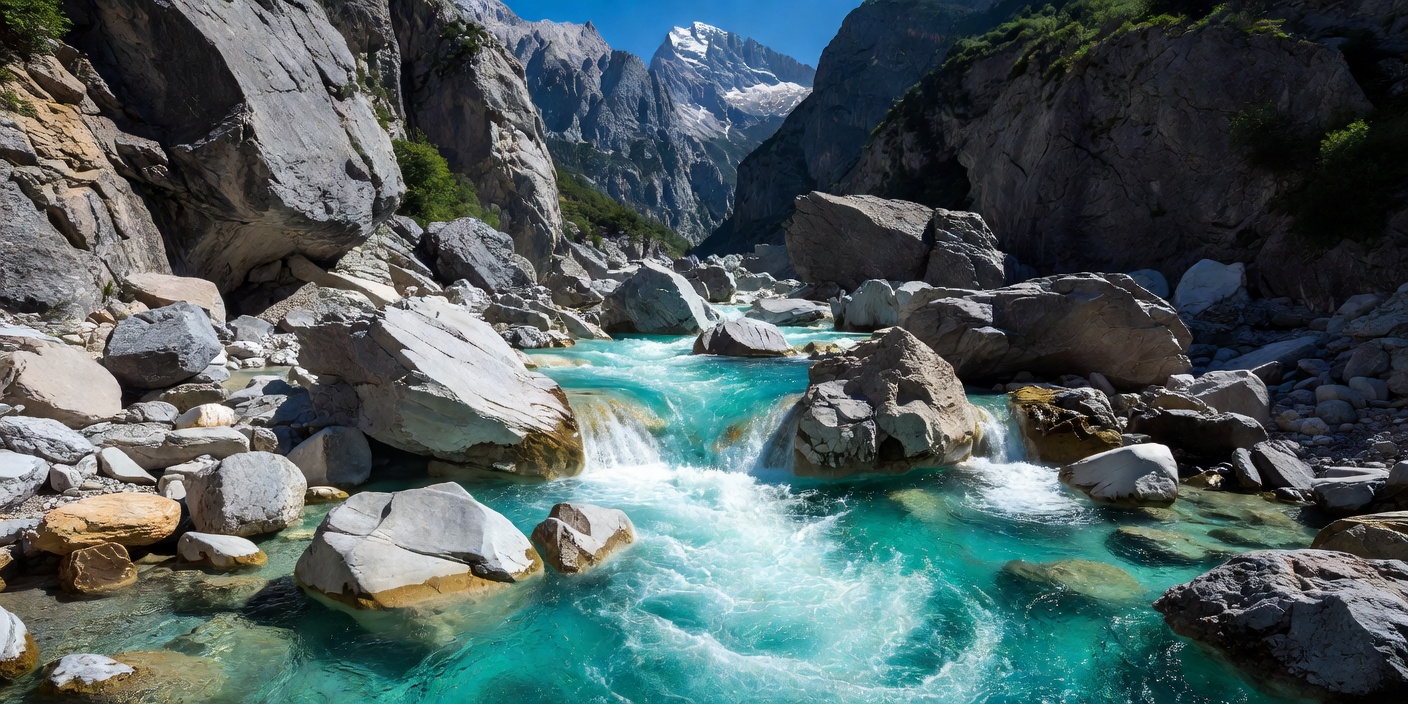
Geology of the Emerald River: Mineral Suspension & Karst Flow
Rising from a karstic spring inside a limestone cavern near the village of Trenta, the Soča River (known historically in Italian as the Isonzo) spans 138 kilometers before draining into the northern Adriatic Sea. What distinguishes the Soča worldwide is its unyielding, luminescent emerald-aquamarine color. This visual wonder is the consequence of extremely low organic sediment concentrations paired with ultra-fine limestone and calcium carbonate particulates suspended in water that rarely exceeds 9°C to 11°C, even during peak midsummer.
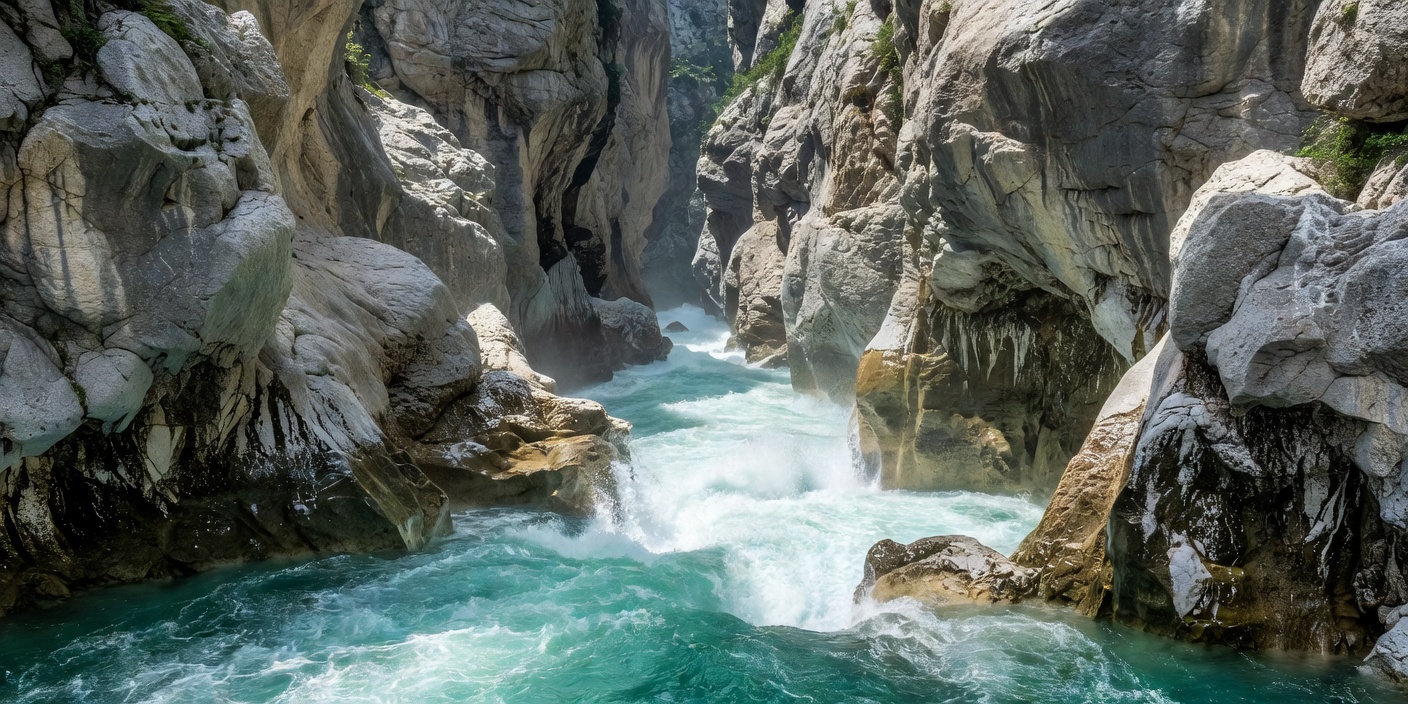
Throughout the Trenta Valley, the river sculpts extraordinary geological formations known as korita (troughs or gorges). The most notable is the Great Soča Gorge (Velika korita Soče), spanning 750 meters with sheer, vertical limestone walls dropping 15 meters down to channels as narrow as two meters wide. Further downstream, the Little Soča Gorge (Mala korita) and the Tolmin Gorges (Tolminska korita) highlight the junction where subterranean thermal springs meet icy mountain torrents.
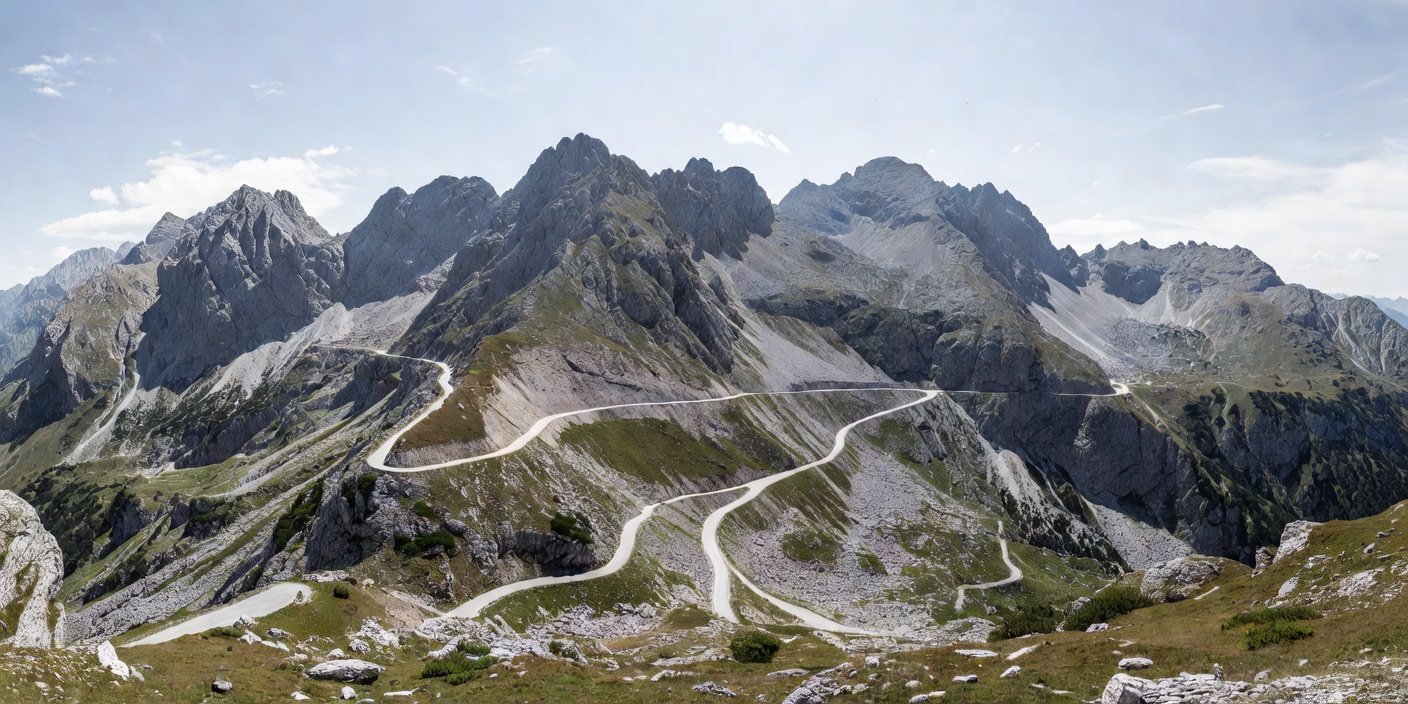
Vršič Pass: 50 Serpentine Turns Over the Julian Crest
Traversing between Kranjska Gora in Upper Carniola and Trenta in the Soča Valley demands navigation of the legendary Vršič Pass (1,611 meters), the highest paved mountain pass in the Eastern Julian Alps. Constructed under severe conditions by over 10,000 Russian prisoners of war during World War I to supply the Austro-Hungarian front lines, the road is engineered with precisely 50 numbered switchbacks (24 on the northern slope ascending from Kranjska Gora, and 26 descending into Trenta).
Vršič Mountain Pass Operational Window
Due to heavy alpine snowpack and avalanche hazards across the Mojstrovka slopes, the Vršič Pass is generally closed to regular vehicular traffic from early November through late April. While snow clearing occurs regularly in late spring, motorists in May and October must check road telemetry for icy patches on the northern cobblestone curves.
At switchback number 8, the poignant Russian Chapel (Ruska kapelica) stands as an orthodox wooden tribute to hundreds of Russian soldiers buried by a massive avalanche in March 1916. Pausing at the summit saddle of Vršič grants trail access to the sheer limestone face of Mount Prisojnik, famous for its naturally carved "Heathen Maiden" (Ajdovska deklica) rock face and the monumental Great Window (Veliko okno) natural arch.
Whitewater Staging: Bovec, Kobarid, and Adventure Sports
The town of Bovec serves as the undisputed adventure sports epicenter of Slovenia. Flanked by Mount Kanin (Slovenia's sole high-altitude ski resort with operations up to 2,292 meters) and the Soča's roaring rapids, Bovec stages certified expeditions for whitewater rafting, technical whitewater kayaking, and canyoning in the Sušec and Fratarica canyons.
Water regulations on the Soča are strictly enforced by municipal authorities: river navigation permits are mandatory and purchased per vessel per day. The river offers distinct sections for varying skill levels:
- Srpenica I to Trnovo I (Class II–III): The premier commercial rafting stretch, offering buoyant rolling waves, striking views of Mount Krn, and playful boulder gardens.
- Trnovo I to Trnovo II (Class IV–V): High-velocity technical waters, restricted exclusively to licensed expert kayakers equipped with reinforced whitewater hulls and drysuits.
- Čezsoča to Srpenica (Class I–II): Gentle, wide stretches optimal for open Canadian canoes, stand-up paddleboarding, and family float trips.
Historical Memory: Kobarid Museum & The Isonzo Front
Beyond natural beauty, the Soča Valley was the stage for some of the bloodiest mountain warfare in human history. Between 1915 and 1917, the Italian Regio Esercito and the Austro-Hungarian military clashed across twelve catastrophic battles known as the Isonzo Front, vividly immortalized by Ernest Hemingway in A Farewell to Arms.
The Kobarid Museum (Kobariški muzej) provides an internationally acclaimed, objective accounting of the 12th Battle of Caporetto (October 1917), where joint Austro-German forces executed rapid infiltration tactics using poison gas and stormtrooper units to collapse the Italian front line. A 5-kilometer historical walking trail links the museum to the Italian Charnel House (Kostnica), the Tonovcov Grad archaeological ruins, and the secluded Kozjak Waterfall (Slap Kozjak), which drops 15 meters within an amphitheater-shaped underground limestone cavern.
Gastronomy: The Marble Trout and Tolminc Cheese
The culinary identity of the Soča Valley is tied intimately to its geography. The indigenous Marble Trout (Salmo marmoratus), brought back from near extinction through rigorous conservation efforts, is celebrated for its delicate texture and light flavor. Traditionally rolled in coarse cornmeal or buckwheat flour and pan-fried in butter, it remains the defining dish of Bovec and Kobarid gostilnas.
Further up the slopes, the pastures around Tolmin produce Tolminc, an authentic protected Designation of Origin hard cow's milk cheese aged on spruce wooden planks for 60 days to two years. Paired with frika (a hearty highlander dish made of grated potatoes, melted cheese, and eggs), it provides the calories required for demanding alpine ascents.